Pages

Monday, 31 January 2022

A WRITER READING - Danielle Maisano


 A WRITER READING

Danielle Maisano


The first book I remember reading

I have a distinct memory of being quite young and reading a Dr. Seuss book and thinking that I was cheating because I recognised the words and didn’t have to sound them out.


The books which shaped my childhood
 

Little Women was the first novel I read, and I remember struggling through it but just loving it so much in the end. It’s still one of my favourite books. I also used to read my mom’s Danielle Steele novels at quite a young age. I remember my teachers being both a bit shocked but impressed.

The books I read as a teenager

As a teenager I fell in love with The Lost Generation of writers – F. Scott Fitzgerald, Hemingway, Virginia Woolf. Then on to The Beats – Jack Kerouac and the poetry of Allen Ginsburg. I will always remember the look of horror on my great-uncle’s face on a trip to Borders when he offered to buy me a book and I picked out a copy of Howl. He said, “Really, Dani, Allen Ginsburg? He’s a communist.” I didn’t quite grasp what he meant at the time, but I knew I was definitely on to something. Maybe the revelation that poetry could be dangerous. And he still bought me the book and I still have it on my shelf and it’s still one of my favourite poetry collections.

The first book that made me want to be a writer

There are two books I remember reading around the same time as a teenager – This Side of Paradise by F. Scott Fitzgerald and The Sun Also Rises by Ernest Hemingway. I think This Side of Paradise made me entertain the idea and The Sun Also Rises solidified it.  It was like nothing I had read before. I feel in love with it. It’s still one of the few books I can read again and again and it never loses anything for me.


The book (or writer) who changed my view of the world

I was working in a coffee shop in the metro-Detroit area in my very early twenties and a customer walked in and saw me reading Pride and Prejudice. He asked if it was for pleasure or a class and I said pleasure. He then struck up a conversation, he was a former English professor and said the two books everyone should be required to read at least once in their lives were The Brothers Karamazov by Fyodor Dostoevsky and The Fountainhead by Ayn Rand. I followed his advice and this will probably be my most controversial answer.

I couldn’t be farther away from her politically and I had never heard of Ayn Rand before I read the book and knew nothing about her when I read it, but The Fountainhead had a profound impact on me. I don’t know if I would feel the same if I read it again today, but at that point in my life I found its message of individualism, as an artist, a revelation. Of course, it doesn’t work great for society as a whole, but as an artist it is so important to trust your voice, your vision. For better or for worse, (and much to the annoyance of my partner) when in doubt or asked to compromise, I still sometimes ask myself ‘What would Roark do?’

The Brothers Karamazov was also a revelation to me, in a different sense, but both books were very wonderful and powerful influences.

The book which will always have a place on my shelves

The Idiot by Fyodor Dostoevsky.

The books I tell everyone else to read

I learned the hard way that pushing Ayn Rand and Dostoevsky wasn’t always that successful, so I’ll say Elena Ferrante’s Neapolitan Novels. In my opinion they are equally as profound but slightly less controversial.  

The book I didn’t finish

Ulysses by James Joyce. I tried to read it while I was in the Peace Corps, with very little distraction and alternative reading material, and I still couldn't do it. But I’ve just had an interesting conversation with another admired author who advised me to perhaps revisit again at another phase in my life.

The book I am reading right now

Right now, I’m reading two books by the same author - Another Now and Adults in the Room by Yanis Varoufakis. I believe he is one of the most important and inspiring thinkers out there on the left and he is also just an amazing writer as well as an economist, and that is not an easy combination to come across.

The book I turn to for comfort

A Moveable Feast by Ernest Hemingway. It’s so sad and sentimental and beautifully written. And I love being transported to the Paris of the 1920s. It’s such a romantic view of life as a writer. And I most definitely am a romantic at heart.


Thanks for sharing your life in books, Danielle. I share your love for many of these, particularly A Moveable Feast!

You can buy a copy of Danielle's novel, The Ardent Witness here


The Ardent Witness by Danielle Maisano
Award-Winning Finalist in the General Fiction category of the 2019 International Book Awards

When Lily sets off in her new profession as a development worker in West Africa, she hopes it will be the start of a new, more fulfilling life – far from the trendy gallery scene in Detroit.

For two years, in a remote Togolese village, Lily must get used to bucket showers, a life without the internet, and her neighbours’ fear of sorcerers. But as she becomes more deeply involved with the community, and makes friends with a local girl, she finds that trying to help can bring unforeseen and sometimes devastating consequences.

Based on the author’s own experience, this novel gives a startlingly fresh and intimate perspective on how western aid programs are failing Africa. It also shows, with blistering honesty, how one woman’s life can be irrevocably changed by a sojourn in one of the most captivating and complex nations on earth.


Monday, 24 January 2022

The Victorina Press Poetry Contest - What Bethany Rivers looks for in a winning poem


Bethany Rivers is one of the judges for the 2022 Victorina Press Poetry Contest, alongside Adam Feinstein, Maria Eugenia Bravo-Calderara and myself. I asked Bethany what she looks for in a winning poem: 


"It's very hard to define what a winning poem needs to be. I look for the unusual message, one that touches the heart and mind.  I look for concrete images which sing from the senses, have crystal clarity, a poem not shy of being specific and personal. I want to see poems where particular attention is given to the white space, as well as the words themselves, letting the poem breathe and dance its own music."


All the information you need to enter the contest can be found here

MORE ABOUT BETHANY


Bethany Rivers has published two poetry pamphlets: the sea refuses no river, from Fly on the Wall Press; Off the Wall, from Indigo Dreams. She is also author of Fountain of Creativity - Ways to nourish your writing. She is editor of As Above So Below, online poetry magazine.  

 You can buy a copy of Fountain of Creativity here


Interview with Steven Jenkins - author of The Nobody Man

Today I'm welcoming Steven Jenkins to Troutie McFish Tales, to talk about his novel, The Nobody Man, as well as his life influences and writing processes.


THE NOBODY MAN

In the moment of truth, what would you do? What if your loved ones had been taken in a moment of senseless violence?

Britain’s inner cities in the 21 st century are cursed by violence and lawlessness. The authorities have lost control. Social media worships
wrong-doers and turns them into anarchistic modern-day heroes. Everyday people, trapped in the inner cities sink estates, are terrorised into not speaking out, not reporting crimes.

Hoodlums rule the roost.

When Dan’s family are taken from him by violence, he fights back.

Vigilante? Hero? Violent criminal? Which is he? Which would you become, in his place?

Makes you think, doesn’t it?

“The Nobody Man is a fast-paced read that unfurls in a filmic way with a protagonist I felt sympathy for. I was fascinated by the clinical descriptions of injuries and the ominous sense of place developed in the novel. Brace yourself  – it is a novel fuelled by gang violence, vengeance, racism and drugs but this should be of no surprise to anyone who reads the blurb: it’s a novel that does what it says on the tin.” Gail Aldwin, author of The String Games and This Much Huxley Knows.

 THE INTERVIEW

The Nobody Man is a vigilante revenge novel, a slice of gritty realism, inner-city life at its darkest. Reviewers have described it as raw, uncompromising, and richly cinematic. Can you tell us a little more about how the idea for the novel came about and why you wanted to tell this story?

The idea for the book came when I saw a social media post about an old man, a man who had worked hard all of his life, served in the British Armed Forces, who had done nothing but contributed positively to society, who had his prized vintage motorcycle stolen. The hoodlums that stole it tried to ransom it online and then, when they didn’t get any money, they set fire to it and posted the pictures. I was incensed, and I tried to imagine what the owner of that bike would feel like. The rest of the story just fell into place around that. I wanted to tell the story because I think most people in the UK see plenty of movies about how tough life is in the hard cities of the USA, but don’t realise that there are worse places right here. There is a whole nasty underbelly of society here in the UK that people aren’t aware of. 

The Nobody Man certainly has an element of vigilante revenge to it, but the protagonist, Dan, constantly struggles with his own ethics and morality. Is he becoming as bad as the criminals he opposes? Should he try to let the authorities deal with crimes against him? If not, why not? Why would he feel that the authorities would fail him and other victims of crime in modern Britain? And of course, with Jonah, the story shows that some criminals are able to change and rehabilitate, given the chance. Jonah is a petty criminal but also a victim of circumstance. This is explored in more depth in the sequel to The Nobody Man, should I ever finish it!

Dan is a paramedic with a military background – which I believe is similar to your own background. Most writers deliberately avoid making their main characters appear too similar to themselves – was this a deliberate choice you made, and if so, do you think you were trying to tell your own story at some level?

I used the old cliché “write what you know about”, I guess. I didn’t construct Dan’s character from my own. He is a far more intelligent and interesting person than I, because I had free rein to make him that way. It was never meant to be my own story, although I ended up using anecdotes from my childhood, from my military career and from my paramedic role. Some of those violent episodes in The Nobody Man were based on real life events, not necessarily from my life, but from the lives of those people I grew up with on the estates in Walsall. Real life events are often more incredible than fiction, that’s why the genre of real life crime is so popular.

I don’t think I was trying to tell my own story. I wanted to tell the stories of ordinary people, stuck in the horrible sink estates of Great British society. They deserve to have their stories and their struggles told.

You were brought up on a deprived housing estate, but were nevertheless encouraged to write at school, and the headmaster, Col. William Flood, also encouraged you to join the British Army. Do you think your life would have been totally different if it hadn’t been for your education at Hydesville Tower School?

Yes, definitely. If I hadn’t been so lucky to go to Hydesville, my life would have turned out very different indeed! The housing estate I grew up on was a stark contrast to the school I attended. One extreme to the other. I’m not sure why my mother decided to send me to a private school, Hydesville, from the kindergarten stage, but I knew by the time I reached secondary school age that there was no way I could just drop back into a state school. There’s nothing wrong with state education, I’m not implying that at all. But the two schools in my area were really brutal hard-knock schools and the kids who went there were part of a social group that I had not been initiated into. Kids can be horrible, really vicious, and standing out as different is a sure-fire way to get your life ruined by becoming a target for bullies. I knew this, and I also knew that if I hadn’t managed to gain the scholarship to Hydesville secondary school, I would not be attending the local comp. One way or another, I would not go. My mind was definitely made up about that. In all truth, the thought of it absolutely terrified me! A good friend of mine, who was the basis for one of the main characters in The Nobody Man, spent a lot of time telling me how he was really scared, every day, to attend school in one of those comps. He rarely went, played truant a lot, eventually dropping out of the education system altogether by the time he was fourteen years old without even learning to read or write. He wasn’t a weak person, he was a bit of a scrapper and a lovable rogue, but he was bullied to the point of having suicidal thoughts. This was Great Britain in the 1980s, when there was no support for kids with this sort of problem.

Colonel Flood was a very influential character in my life and the encouragement that I received from him and other teachers certainly made me write. It was a method of desperately needed escapism and those teachers must have been decades ahead of their time to be so insightful.

Joining the British Army was the only safe decision to make when I left school. The other choices would have been either risking becoming a lifetime member of the “benefits generation” or choosing a life of crime. It was so easy for young people to make the wrong choices, and once those choices had been made they were virtually impossible to change. Most of the kids from Hydesville went on to be doctors or lawyers or other professionals. I didn’t consider those options, not because I thought I was too stupid, but because I thought those career choices weren’t for kids like me. If one of my school friends told his parents he wanted to become a doctor, there was a strong chance that one of the parents was a medical professional too, or one of their friends or family members were. It wasn’t outside their social circle. It would have been attainable and almost expected. I may as well have told people I wanted to walk on the moon as say I wanted to become a solicitor! Looking back, I see that I could have chosen a career like that if I had really wanted to, but I didn’t know how and I didn’t realise I just had to ask someone for guidance. Life was very different back then. Most people followed their predetermined social pathways. Only the most outstanding or unique characters were strong enough to say, no, that’s not what I want to do. That was my misconception of things anyway, and by the time I had realised I was wrong, I was all grown up and already on my own pathway. I think that Colonel Flood knew how I felt and he also knew that joining the army would change me as a person and make me stronger, mentally as well as physically.

Do you think it is harder for working class authors, writing about working class lives, to achieve mainstream success?

No, I don’t think so, certainly not now. Perhaps yes, in the 1980s, but not now. The internet has opened up so many options because it shows everyone that there are other life choices. It shows how other people have achieved what they wanted, regardless of their social class. When I left school I knew that anyone could write stories, but I didn’t know how they got them published. The main problem in getting published now is very different to the 1980s. The dreaded subject of political correctness is ever present in the 2020s. It stifles creativity and it makes the average person’s opinions taboo. I read a decent article here https://www.theguardian.com/books/2020/may/01/publishers-must-act-now-to-develop-working-class-writers-report-common-people I agree with some of it, but I don’t think that there is a lack of social diversity, in fact I think that the opposite is true, thankfully.

The Nobody Man has been praised for its raw authenticity. Was it difficult to ‘live’ in such a bleak world while you were writing the novel, or did you see it as an extension of the world you grew up in? What was your biggest challenge when writing the novel? And what did you enjoy most about the process?

The Nobody Man did become a sort of extension of that world, yes, although I hadn’t thought of it like that until you just asked that question. I tried to bring all the different small stories, from various sources and even from different timeframes, all together in the overall story.


My biggest challenge when writing The Nobody Man was time management. My job involved a lot of studying, in my own time, and juggling the novel’s deadlines was challenging. Not impossible though, and time management became an important part of the writing process. I set myself a word count target per month, and kept track of it. Eventually, those deadlines helped to complete the book. If I hadn’t had the pressure of finishing the book in the timeframe agreed with Victorina Press, I might never have finished it. I really didn’t want to let Consuelo down. She’d shown faith in me, and I wanted to at least finish the first draft on time. If she had read the finished product and not liked it, that would have been disappointing, but at least I would have known that I hadn’t let her down by being lazy and not producing the goods. 

I enjoyed developing the characters. The extra snippets, the short stories I wrote about some of the main characters on the facebook page of The Nobody Man were initially done while writing the first draft. I never realised that this process would help to strengthen the characters in the book. I think I got the idea from Stephen King. Those snippets were never intended for publication in the novel but I really enjoyed writing them.

Are you a fast or slow writer? Do you find it difficult to carve out time to write, or are you quite disciplined?

I don’t consider myself a fast writer at all. I know of some writers that can do 5-10 thousand words per day! It takes me a month to write 10,000 words that I am happy with. Once I set my own deadlines, I am quite disciplined. Any writer has to be. I schedule writing time into my diary and stick to it.
 
Your publishers, Victorina Press, believe very strongly in the principles of bibliodiversity. What does this mean to you personally and was it a factor in your decision to submit your work to them?

Personally, I don’t think that bibliodiversity is perceived as an important concept in the free western world, as we have always been lucky enough to have freedom of speech and freedom to express ourselves with the written word, whether that is factual writing such as journalism (sometimes!) or whether it is creative freedom expressed as fictional writing. I don’t mean that it isn’t important, far from it, but we have taken it for granted, in the same way as an indigenous tribesman might not consider the importance of freedom to wander and hunt in their land until it has been taken away by the imperious colonial invaders.

When I was growing up, I read books that described how some dictatorships would enforce burning books policies and restricting people’s freedom to read or write whatever they wanted. I saw it in movies too, but I didn’t truly appreciate how destructive this book burning policy was, how it was a method of control, of demonstrating power of the state over the individual. I couldn’t imagine living in a state where I couldn’t read whatever I want to, but I know that it happens in many countries. I think that bibliodiversity is an absolute right of the individual in a free society. I applaud Victorina for bringing this concept to British awareness, however it wasn’t a factor in my decision to submit my work to them, because I never saw lack of bibliodiversity as a problem in this country. Of course I may be wrong on that, but I hope not.

I sincerely believe that political correctness is the most stifling restriction on creativity in the UK at the moment.

What is next for you as a writer? Another novel, or something completely different?

Unfortunately, life events across the world have changed my plans over the last couple of years, and since the publication of The Nobody Man. A significant life event in 2019 stifled my creativity and then the pandemic of the last two years has meant that I have been working flat out in my NHS frontline role. I have also started my own business, as an exit strategy from the aforementioned NHS role, and like a lot of small businesses worldwide, it has been challenging. As you can imagine, the time constraints have left few spare periods to write creatively and productively. As things are now hopefully settling down again, I find myself reading a lot more and this is inspiring me to continue my writing again.

I started a sequel to The Nobody Man, with some of the original main characters, and I also started a completely different genre of book.

I wanted to write the story of a man and his journey through dementia after his diagnosis and subsequent decline, seen through his own mind’s eye and through the experiences and frustrations of his family as they deal with this terrifying disease. I’ve used my own experience for this book, from seeing a family member suffer from Alzheimers and from the work that I do in the NHS.

In lots of ways, this story is completely different from The Nobody Man, but it is also intended to be similar in the way it portrays difficulties of the ordinary British person when dealing with societal problems and the infuriatingly complicated system that we live in.

I wanted The Nobody Man to make a statement on British society, and this other book would also be written with that in mind.


Thanks for talking to me, Steven. I wish you well with all your future writing projects – and your new business venture.

You can buy a copy of The Nobody Man here


Thursday, 20 January 2022

Interview With Writer M Valentine Williams

Today, I'm welcoming M Valentine Williams to my blog to talk about her forthcoming book, Losing It, and her dystopian novel, The Marsh People, both published by Victorina Press.

Review – Losing It:  "A stark, cleverly-written book. Despite a very difficult subject the author manages to draw us very quickly into Jane's small world and those who people it. More importantly, we are drawn into Jane's mind. and with that her terrors and her awful nightmares. Although it's written in quite a pared-back style, with short, fast chapters, the author uses wonderful detail to paint Jane's surroundings. Few NOvels will pull you in as forcefully as this - or ensure that your sympathies will lie so completely at the end with a character like Jane."


Welcome to Troutie McFish Tales, Mary! Losing It is your second title to be published by Victorina Press – however they are two very different books. The Marsh People is dystopian fiction “pitting outsiders against inhuman tyrants”, whereas Losing It is a novel set in a high security hospital; a harrowing story of redemption and compassion in a dangerous and uncaring world. Can you tell us a little more about the novel, and about the character of Jane?

I had heard from staff working with imprisoned people labelled ‘criminally insane’ and was impressed by the understanding and care they gave to these people. They understood that faced with the full knowledge of what they had done, many could not live with themselves. Jane, damaged by her own early childhood, cannot escape the reality of her situation, or her part in the deaths of her own children. When the  well-meaning doctor opens these old wounds, she takes her own life. I wanted to give a voice to Jane and other women like her, who society calls monsters, in an effort to aid understanding of how people become shaped and formed by early traumas and a society that doesn’t care. Jane is a person, not a headline or a statistic.

I know you have worked in mental health in the past. Is that why you wanted to tell this story? Do you often look to your own life for writing inspiration?

I don’t write much about mental health matters, partly because of confidentiality - I don’t know any Janes - but also because I find it depressing myself! But I do find people ‘on the edge’ fascinating, interesting and sometimes more alive than your average person. I’ve been lucky enough to have met some extraordinary people and heard their stories, and I’ve been down and out myself from time to time; it’s all grist to the mill.


In contrast, The Marsh People is set in a wholly imagined world – one which has been highly praised by reviewers for its feeling of authenticity. Did you enjoy creating this bleak dystopia? Do you find it easier to write about the world you live in or the worlds you create?

The Marsh People was partly based on an experiment with dogs carried out by Seligman, on ‘learned helplessness’. In this experiment, dogs were kept isolated in small enclosures with electrified fences, but with comfortable kennels, and were fed regularly. When the electric fencing was turned off, most dogs stayed put, despite having no real freedom. One or two, however, jumped over the fencing and made a bid for freedom, not knowing how they would survive out there. In The Marsh People, I put the dogs in charge and let Scummo and Kelpin out into the wide world to survive as best they may. The world outside the City reflects my own childhood in a way, as I hated school and spent as much time outdoors as I could.
    More recently, coming across discarded clothing in a derelict warehouse, I realised rough sleepers had lived there and tried to imagine what it must be like to wake up in this bleak, draughty passageway - and The Marsh People was born.


Losing It covers sensitive issues and explores what goes on behind closed doors in a secure hospital unit. You must have been constantly aware of the need to portray this world accurately. What was your biggest challenge when writing it?

This is a hard one to answer. I did a lot of reading, talked to a good many people who worked in these settings, and have worked myself in Special Schools and in a prison. As a psychotherapist, one of the main challenges in writing is making sure there are no identifying details or any details people could regard as relating to them. The interviews between Bruce and Jane, for instance, are pure invention. So are all the characters. The challenge is to recreate them so that they could be understood as real.

Both of your novels are quite dark. What did you enjoy about writing them?

I like exploring the darkness. Testing myself and letting my imagination have free rein.

Are you a fast or slow writer? Do you find it difficult to carve out time to write, or are you quite disciplined?

I can be disciplined, and I’m a fast writer once I’ve started. I once lived over the road from Buchi Emecheta, who got up at five before starting work as a cleaner in order to write while her kids were asleep. I mean, bloody hell...
 
Victorina Press believes very strongly in the principles of bibliodiversity. What does this mean to you personally and was it a factor in your decision to submit your work to them?

My family has people from many places within it, and I love that. I fully support bibliodiversity.

What is next for you as a writer? Another novel, or something else?

Still thinking about that one. I have a half-written novel about the Italian mafia, Ndrangheda, and a woman who shopped the Boss. I’m also writing poetry.


Thanks for talking to me today, Mary. I wish you every success with the launch of Losing It (out Spring 2022 from Victorina Press). 

You can order The Marsh People here


Sunday, 16 January 2022

The Victorina Press Poetry Contest 2022


It is always an honour to judge a writing award, and this year I have been asked to be one of the judges for the Victorina Press Poetry Contest.
    I’m a real lover of poetry and have a large collection of poetry books, many of which I have owned since I was a teenager. I have also written poetry since I was a child, and I achieved early competition success in my grammar school literary contest at the age of eleven – with a poem about George Best! My debut chapbook, The Collective Nouns for Birds, won the Saboteur Award for poetry in 2020, and my first full length collection, talk to me about when we were perfect, will be published in early 2023 by Victorina Press.

    The 2022 Victorina contest, in collaboration with Voces-Voices Festival 2021, is open for entries until February 28th. Poems should be forty lines or less and written in English or Spanish. There’s a £1000 prize pot and the opportunity for poets to see their work published in an anthology. Everything else you need to know can be found here.
    My fellow judges will be Bethany Rivers, Adan Feinstein and Maria Eugenia Bravo-Calderara, and I’m really looking forward to reading all the entries and discussing the shortlisted poems with them in due course.
    In the meanwhile here are a few of my thoughts about some of the things I look for in a winning poem.
    The Victorina contest has a broad and universal theme: Life, Death and Beyond, which I think everyone would agree is the bread and butter territory of the majority of poets. The main topics covered in the poems I’ve read for previous competitions have largely fallen within that theme: death, marriage, funerals, illness, friendships and adultery. These universal themes will always outnumber the quirky and unusual, but they need to be approached with fresh eyes to be noticed.
    At the start of the judging process it always feels like a daunting challenge: will I find poetry with that indefinable magic, with original language, arresting imagery and adventurous ideas to surprise me? Will I be able to identify the poem that – for me – shone above the rest?
    For a poem to work, the poet needs to communicate with the reader, not just talk to themselves. Beautiful language is meaningless if there are no concrete ideas and no clear message. The best poetry is never overcrowded, the words are reduced to an essential essence that dances to a unique rhythm.
    There needs to be a confident voice, and even if that voice is a delicate one, it needs to have surety.
    But a winning poem needs more than deft technique, originality and a clear message. It has to resonate, demand re-reading, it has to touch the soul and linger in the mind.
    Good luck!


Tuesday, 30 November 2021

Queer Life, Queer Love Anthology


 511qekfiSAL


This incredible anthology is a global showcase of diverse and confident queer writing. A heady mix of poetry and prose, fiction and non-fiction, it is powerful and punchy, subversive and boundary-pushing, full of courage and attitude – forty-three different writers exploring all the complexities and experiences of living a queer life. The book, published by Muswell Press, is dedicated to Sarah Beal’s trans-daughter Lucy who died, age 20, in March 2020. It is a particularly fitting way to honour her life, as it was an idea she had discussed with Sarah, with the aim of encouraging new writers and rejoicing in the richness of queer life.


You can buy a copy here

Tuesday, 16 November 2021

Review from Amanda McLeod

I was thrilled to wake up to a thoughtful review from Amanda McLeod today. Here's a taster and the link to the full review:

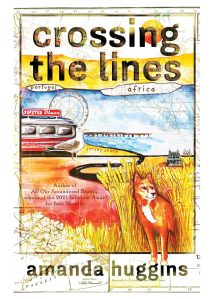
Review – ‘Crossing the Lines’ by Amanda Huggins

Amanda Huggins is a writer with an eye for the details in the everyday that bring a story to life (see my reviews of All Our Squandered Beauty and Scratched Enamel Heart). In her novella Crossing the Lines, we follow Mollie as her mother Ella drags her from her home on the New Jersey shore to a farm a thousand miles away, on the promises of a man. 

From the beginning, Mollie is distrustful of Sherman; there’s something in his eyes that gives him away. As the story unfolds it becomes evident that Ella is also conscious that Sherman was not the man she hoped, but expectation and humiliation force her hand and she goes ahead with the move to the farm knowing it puts both her and Mollie in danger. As dreams unravel and Sherman’s nature becomes fully apparent, Mollie realises that if she doesn’t save herself, no one else will. 

There’s a diverse cast of characters here, quite disparate but all joined to the narrative by their interactions with Mollie, no matter how fleeting. The messages in these interactions follow two main streams. The first is that kindness heals, offering a kind of catharsis that allows people to release their pain and move forward. The second is that the vulnerable, over and over, are let down by those who are meant to keep them safe and that cycle is difficult to break. Mollie is let down by almost all the adults in her life; Ella’s own issues with abandonment are a precursor to her treatment of Mollie; even Sherman, a victim of childhood abuse, is able to recognise in the end but not break the pattern in his own life. (continued)

You can read the full review here

Crossing the Lines is available for preorder now from Victorina Press.


Thursday, 4 November 2021

Just a month to go before the release of Crossing the Lines!


It's nearly publication day for Crossing the Lines! The physical proofs are about to go out, and I've already had some lovely reviews from readers who've read the e-book proof.

This novella is a little darker than some of my other fiction, a little grittier, so I was wary of how it would be received by readers who've enjoyed my other work. But luckily they seem to really like it – sigh of relief!

THE BOOK

When Sherman Rook walks into the Jupiter diner, Mollie’s mama is instantly smitten. Despite her daughter’s reluctance, they leave the New Jersey shore behind and move to his isolated farmstead over a thousand miles west.

Fifteen-year-old Mollie distracts herself from Rook’s cruelty by befriending a stray dog she names Hal, but when Rook crosses a final line Mollie realises that sometimes we must leave behind those we love in order to save ourselves.

With only $20 to her name, she sets out from Oakridge Farm, relying on luck and the kindness of strangers as she makes her way back home across five state lines.

You can pre-order here

THE REVIEWS

'This is a beautifully written novella, where layers of the narrative build to offer insight into two communities and many relationships. Mollie, the young protagonist, travels treacherous landscapes and grows wiser for the journey. Crossing The Lines shows it’s possible to break intergenerational cycles of behaviour . . .  or not. Amanda Huggins uses skilful, sensory prose to offer a wonderful reading experience. What a joy!' Gail Aldwin - author of This Much Huxley Knows

'An atmospheric and haunting coming-of-age story of a young girl escaping her fate and returning to her roots. With compelling characters and evocative prose, this is a journey of self discovery that will stay with you long after you read the last line.' Sarah Linley, author of The Trip

'A road trip across America, the mistakes and lessons that pass across generations – Crossing the Lines by Amanda Huggins follows the journey of mother and daughter Ella and Mollie as they head west with the dubious Sherman Rook. First loves, lost loves, an unsettling and lingering threat of violence, Huggins creates a dusty, middle American landscape that acts as a backdrop for Mollie’s incident filled trek home to the East Coast. This is a beautifully written, tightly constructed novella, almost poetic in its descriptions. Huggins has a masterful grasp of language and within a few pen strokes creates characters that are wholly believable. The narrative arc works well within such a few pages and Huggins controls the pace and direction of the story with great skill.' Mike Lewis, author of If God Will Spare My Life

'Another beautiful novella from Amanda Huggins. I read in one sitting. It feels darker and edgier than some of her other stories and is drawn with an expert hand. As always, her writing style gives the reader enough but never too much; profound and unpretentious. Narrated in the third person, the novella shows a variety of characters’ perspectives, switching in each chapter. It felt unobtrusive, almost seamless. That is quite a feat. Though Mollie is the protagonist, I found myself sympathising with most of the characters, even the unpleasant ones, because they are well-rounded and believable with fleshed-out backstories. Amanda draws you in and before you know it you’ve reached the end. It is satisfying but makes you curious to know what happens next. It would have been easy for her to tie up the loose ends, but she chooses a subtler, more nuanced ‘open conclusion’. I love this realistic depiction of life, in all its messy complexity! Through her empathetic depictions, we experience the intricacies of the human experience, their vulnerabilities, and their desire to be saved. Some of the characters end up in a good place; perhaps the other characters can overcome their inner demons and choose a better path too. Who knows? Well…I sensed that there was hope.' Hannah Ruth Retallick

Wednesday, 27 October 2021

Interview with author Caroline Moir


A warm welcome to Caroline Moir, whose novel Brockenspectre will be published by Victorina Press on 12th November.

THE BOOK

Brocken spectre: the magnified and detached shadow of an observer; typically on a mountain
 

The peace of an isolated Lake District university campus is disturbed by the arrival of mature student, Hild. For Miriam and Ed, the newcomer brings darkness and disorder which reshapes every aspect of their lives, and strikes at the core of their relationship.

Miriam is determined to exorcise the shadow Hild has cast, but how? And can she justify keeping another woman out of the light, the education, she has enjoyed?

Brockenspectre was shortlisted for the Sceptre Prize in 2013

You can pre-order a copy here.


 THE INTERVIEW

Congratulations on the publication of Brockenspectre. There is an intriguing story at its heart, but this novel also feels like a love letter to the Lake District – how important is a sense of place in your work?

I am not sure it is a love letter. I have a love-hate relationship with the Lake District – it rains a lot! In my early life rain was an event – I remember ‘swimming’ in the rain on a verandah as a young child. In the Lake District you factor it in to whatever you do.  But a sense of place is hugely important in my work. My first novel was largely set in the New Forest, my most recent novel is set in British Columbia, and in my memoir-in-short-story place is crucial. I think it is because I was brought up until I was thirteen abroad, paid long visits to my father in the Middle East, and have lived and worked in the USA and Canada.  For me places are characters in my fiction, and even, I think, in my plays.

I believe you wrote the original version of Brockenspectre quite a while ago. Tell me a little more about where the idea originally came from and how it has developed and changed?

The original stimulus was twofold. My husband was being stalked by a parishioner and one day I wondered whether you could get rid of someone by ‘writing them out’. Originally I didn’t want Hild, the stalker, to have a voice in case she dominated Miriam. However I felt that was too one-sided and I gave Hild, and Miriam’s partner, Ed, voices, which makes the novel less partisan, more understanding and more balanced. I was astounded the other day to read the first version and realised it began with the Christmas ball where the published version ends.

Who is your favourite character in Brockenspectre and what do you love (and hate!) about him or her?

I don’t have a favourite character in Brockenspectre but I am really interested in the two main characters, Miriam and Hild, what makes them tick, and how, despite their antipathy, they are similar. You can’t have one without the other.


I’ve heard you mention that some readers think Hild is not a real character, but rather a figment of Miriam’s imagination. Did you deliberately set out to create this ambiguity and mystery?

No, I didn’t. Because I didn’t want Miriam to have a one-way street of antagonism towards Hild, then Hild becomes like her and yet not like her. Curiously when I was first writing Brockenspectre, I was also reading a lot of Nathaniel Hawthorne who is a very unsettling author. I came across his novel The Marble Faun which I hadn’t read and discovered it also had two characters at odds with each other called Miriam and Hilda. That, and the fact that I began the novel on the day I started Margaret Atwood’s Robber Bride, having had it on my shelf for ages, and found it had a similar theme and opened on the same date, sent shivers down my spine which may have led to ambiguity and an almost claustrophobic atmosphere.

Who are your favourite writers and have they had an influence on your prose style?

I don’t have favourite writers – I have enthusiasms for one writer after another and bore my friends with my discoveries! I read a lot of European and fiction from round the world, particularly from the Americas and Caribbean. At the moment I am hooked on Monique Roffey and Tessa McWatt, who are British and published in this country, but whose settings and themes stem from their ethnicity and upbringing. Saying that one of the books about which I am persistently enthusiastic and which has influenced me stylistically is Train Dreams by the sadly now dead American writer, Denis Johnson. I marvel at the transparency of his prose.

Brockenspectre is your second novel – the first being Jemillia in 2007 – and you are also a playwright and short story writer. What are the different challenges you face when crafting these alternative forms?

I am a playwright by commission. I have considerable experience of youth and community theatre and when I started writing short stories and novels I tended to write them as if they were plays – lots of dialogue and not much else. I had to flesh the fiction out. I still have difficulty writing at length I have had short stories published but I am not sure that I am a classic short story writer. Though I very much enjoy reading both, I find it difficult to close my fiction, which I think is demanded by the novella and short stories – and plays. I like the open-endedness of the novel form.

Your publishers, Victorina Press, believe very strongly in the principles of bibliodiversity. What does this mean to you personally and was it a factor in your decision to submit your work to them?

For me bibliodiversity represents an opportunity to publish all kinds of authors and all kinds of genres from many different countries. Bibliodiversity is not restrictive. I submitted Brockenspectre to Victorina Press for precisely that reason. The novel doesn’t fit the current bill, because in it I examine what happens when ambitious women are in competition. I also submitted the novel and Brockenspectre is set in the English Lake District and Argentine and Chile. I greatly admire what Victorina Press is doing.  

What can we hope to see from you next? A new novel, another play, or something else?

I am working on a prequel to my very short novel – not a novella! – Hunting Jenet Nish which is set in British Columbia between 1914 and 1971, and which recounts Jenet Nish’s search for her mixed-race namesake

Thank you for talking to me today, Caroline. Good luck with Brockenspectre – I hope it flies off the shelves!


MORE ABOUT CAROLINE

Caroline Moir was born in the Sudan and has lived and worked in places as far apart as Newfoundland and Syria, Italy and Argentina. 

She is re-writing her first novel Jemillia, set in a future New Forest and Edinburgh, and has just completed Hunting Jenet Nish, set in British Columbia, the first of a historical trilogy.

As a playwright she was commissioned to write St Wilfrid of Ripon 2009, by Ripon Cathedral, and by Kendal Community Theatre A Passion for Kendal 2012, Lady Anne Clifford – a woman cast out 2013, and The Wednesday Play ~ plot to kill Jesus 2015. She was Literary Director for Kendal Yarns Festival of New Plays in 2016.
 
She has read her work for the BBC, at the Edinburgh International Book Festival, and at ‘Aye Write’ in Glasgow, and most recently at Lancaster LitFest 2019 and online with Yvonne Battle-Felton. She has a PhD in Creative Writing from Glasgow University. 

Her memoir in short stories, the swaying corridors of the wagons-lits, was long listed for the Cinnamon Literature Award in 2020.

You can pre-order Brockenspectre here.


Tuesday, 19 October 2021

Interview with Rhiannon Lewis


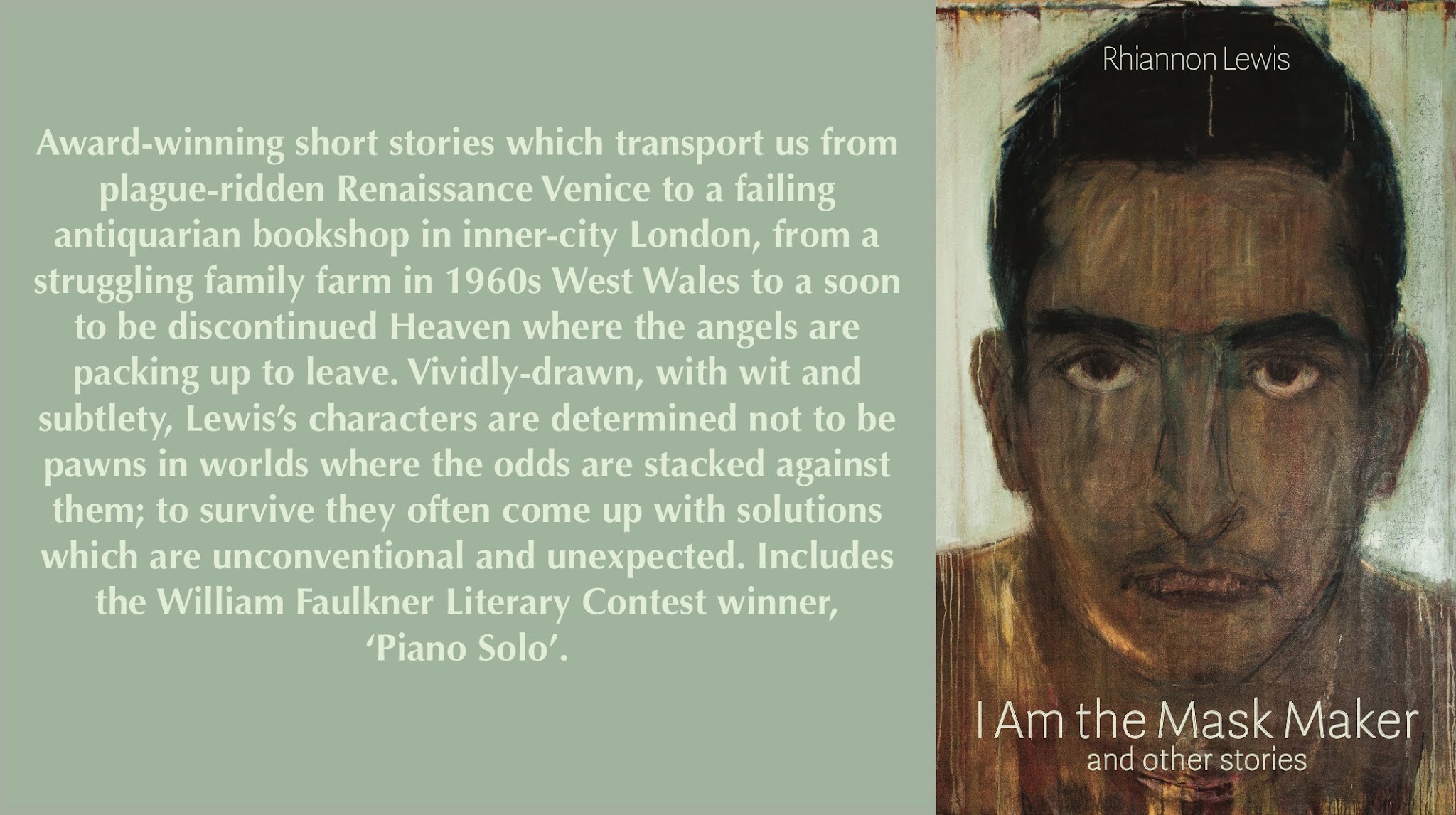
Today, I am delighted to be talking to award-winning novelist and short fiction writer, Rhiannon Lewis. Her new collection, I Am the Mask Maker, comprises eleven of her compelling short stories, and will be published by Victorina Press on 30th October.


 THE BOOK

A collection of award-winning short stories which transport us from plague-ridden Renaissance Venice to a failing antiquarian bookshop in inner-city London, from a struggling family farm in 1960s West Wales to a soon to be discontinued Heaven where the angels are packing up to leave. Vividly-drawn, with wit and subtlety, Lewis’s characters are determined not to be pawns in worlds where the odds are stacked against them; to survive they often come up with solutions which are unconventional and unexpected. Includes the William Faulkner Literary Contest winner, ‘Piano Solo’.

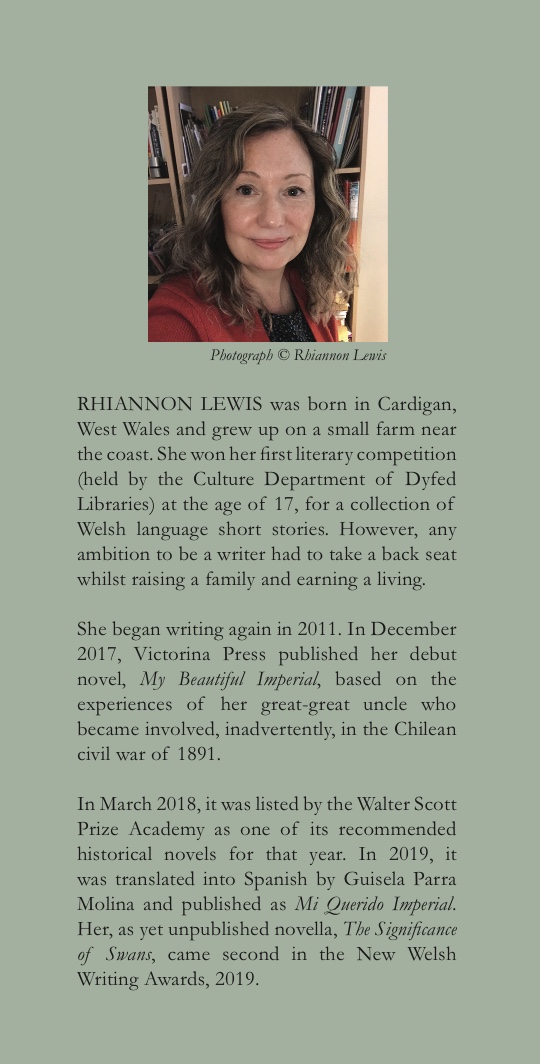
THE AUTHOR 


THE INTERVIEW


Congratulations on this brilliant collection. Many of the stories have won awards or been shortlisted for writing competitions. You must have been particularly thrilled to win the William Faulkner contest last year?

Thank you. Yes, I was thrilled, particularly as I was the first UK winner since the competition was established in 1997. I still can’t get over the fact that my story meant something to a judge from as far away as New Albany, Mississippi. The competition is held annually in William Faulkner’s hometown. Under normal circumstances the prize would have been awarded at a dinner for over a hundred guests. Because of Covid-19 I wasn’t able to travel there to accept the prize. One day, when things are safer, I’d love to go there to see William Faulkner’s home, Rowan Oak, and his hometown of New Albany. 


Who are your favourite short story writers and have they had an influence on your writing style?

I don’t have a favourite as such. I think you can learn something from every writer and there are so many good writers to choose from. I would have to mention Raymond Carver. His stories seem so banal on the face of it, but utterly striking – the way they get under your skin. 'The Fox' by D H Lawrence is one of my favourite short stories of all time. I go back to it time and time again. I love the way he creates a feeling of impending disaster right from the start. Lately, I’ve been reading the work of Jean Rhys. She breaks ‘the rules’ all the time, which I love. Though you shouldn’t read Jean Rhys if you’re feeling in the least bit depressed.

Your stories are set in many different countries and locations – how important is a sense of place in your work?

When you write a short story or a novel, it is necessary for you to want to be in that place for a while. I’ve started many stories and then thought, oh, I really don’t want to spend too long in this place – it’s not interesting enough or it’s too close to something I know too well and can’t be objective about. Often, taking a story and transposing it to a different place altogether, perhaps even somewhere you have to make an effort to research, can give a story a new lease of life and a better perspective. A sense of place is very important but so is imagination. Writers are told all the time to write about what you know. But don’t forget your imagination! That’s the most useful thing of all.

Who is your favourite character in your stories and what do you love about him or her?

I love all my characters! Saying that, I would rather be stuck on a desert island with some rather than others. One or two would know exactly how to build a tree house and find something to eat. Others would just curl up under a palm and be of no use whatsoever unless they had a piano with them, which would be unlikely on a desert island. Of all the characters I’ve written about, Aeronwy in 'The Significance of Swans' is the one I admire most. She manages to stay sane in a situation which would defeat most of us, including myself. Davy, the lead character in My Beautiful Imperial is the one I would want to have with me on a desert island, however. He’d know how to build a boat and how get us home in one piece, no matter what the conditions. And he’d probably make me laugh quite a bit on the way.

You write novels as well as short fiction. What are the different challenges you face when crafting these alternative forms?

I think of a short story as a sprint and a novel more like a marathon. Or to use another analogy, when you’re embarking on a novel, it is a bit like boarding a ship that’s bound for another continent. You have to be prepared to be there for a long time. You know there will be hardships and challenges, as well as adventures and excitement. You have to have faith that you’ll get there in the end. Some short stories come to you fully formed. Others start with a single line and you go from there. With a longer work, I don’t like to plan too much. I’m not one of these writers who outlines everything on a pin-board and knows exactly what they’re going to be writing in each single chapter. What would be the fun in that? I will have a vague idea of where the book is going – especially if I’m writing historical fiction and I’m trying to stay faithful to the facts – but on the whole I like to start off not knowing too much about what’s ahead. That way, the story and the characters can grow through the story. Writing a short story or a novel should feel like an adventure not a chore. 


Your debut novel, My Beautiful Imperial, was based on the experiences of your great-great uncle who inadvertently became involved in the Chilean civil War of 1891. It must have been fascinating to dig deep into your family history? Was his story something you had been wanting to write about and explore for some time, or did you learn about it more recently?

I spent over twenty years researching the story of the steamship Imperial and my great-great uncle’s involvement in the Chilean civil war. At the time, I was working full-time so there was no possibility of writing a novel. And in any case, the research was something I was doing for my own interest. Gradually, it became clear to me that the whole story would be completely forgotten if no one wrote about it. At around 4am on 11 April 2011 I scribbled the date on the top of a school exercise book and began writing, thinking that I wouldn’t stop until I’d told the whole story. It took me three years of writing in my spare time but now it’s there for everyone to read.

Your publishers, Victorina Press, believe very strongly in the principles of bibliodiversity. What does this mean to you personally and was it a factor in your decision to submit your work to them?

I’d never heard of the principle of bibliodiversity before I met the founder of Victorina Press, Consuelo Rivera-Fuentes, but it means a great deal to me. When you start writing, people are desperate to put you into a particular box or category. I was a woman, writing about a man who had taken part in a civil war on the other side of the world. I was also Welsh, but writing in English. Neither I, nor my work, seemed to fit into any convenient box. Consuelo was prepared to look beyond these things and to read my work on its own merits. I was so pleased that My Beautiful Imperial was recommended by the Walter Scott Prize Academy soon after it was published because it was the best way to repay Consuelo’s faith in my story. I love the fact that Victorina Press is publishing books by such a diverse and ever-expanding group of voices.


What can we hope to see from you next? More short stories, a new novel, or something else?

This autumn, I really want to get my teeth into another longer piece of work. I’m researching a few different ideas at the moment. There’s nothing like the feeling of being immersed to the point where the work and the characters sometimes feel more real than what’s around you, day to day. But we’ll see. The short stories have way of butting in when you least expect them!

Thank you for talking to me today, Rhiannon. Good luck with I Am the Mask Maker – I hope it flies off the shelves!

You can pre-order I Am the Mask Maker here.


Thursday, 30 September 2021

Interview with the poet, Jennifer Langer


I’m delighted to welcome Jennifer Langer to Troutie McFish Tales to talk about her newly released poetry chapbook, The Search, which I had the privilege of editing for Victorina Press.

THE POET

A long-time writer of poetry for herself, Jennifer’s work has been published in various magazines and she is a member of an inspiring poets’ collective. Jennifer is editor of four anthologies of exiled literature: The Bend in the Road: Refugees Writing (1997), Crossing the Border: Exiled Women’s Writing (2002), The Silver Throat of the Moon: Writing in Exile (2005) and If Salt Has Memory: Contemporary Jewish Exiled Writing (2008) all published by Five Leaves. She is lead editor of Resistance: Voices of Exiled Writers (Palewell, 2020). She is founding director of Exiled Writers Ink which brings together established and developing migrant and refugee writers from repressive regimes and war-torn situations. Established in 2000, it is an ever-expanding organisation that provides a space for exiled writers to be heard, develops and promotes their creative literary expression, and crucially advocates human rights through literature and literary activism. 

Previously co-editor of Exiled Ink magazine, she has written numerous articles on aspects of the literature of exile and has presented papers both in the UK and overseas, ranging from Casablanca to Gothenburg. She also reviews poetry, memoir, fiction and research focusing on migration, exile, memory and identity. She holds a PhD from the School of Oriental and African Studies, University of London, in Cultural Memory and Literature by Exiled Iranian Jewish Women, and an MA in Cultural Memory from the School of Advanced Study, University of London. She is currently a SOAS Research Associate. Jennifer is the daughter of refugees who escaped from Nazi Germany and who met in England. Her parents were both the sole survivors of their respective families.


THE COLLECTION

The Search is an exploration of the poet’s complex sense of identity as the daughter of German Jewish refugees who fled Nazi Germany for Britain. Crucially, her sensibility of otherness is dialogically engaged with contemporary refugees and the oppressed. Born of the history of loss and of refugee roots, the poet dreams of a lost world attempting to snatch at fragments and striving to create a narrative yet she is also compelled to confront current tensions arising from the diverse facets of this identity. Engaged in the attempt to resist negative representations projected onto herself, she struggles to define herself.

 You can order a copy of The Search HERE


 THE INTERVIEW


In the very personal opening poem of The Search, a friend asks “where do you really come from?”, a question which heralds the main theme of your collection. As the daughter of German Jewish refugees, your identity is complex, and I see these multi-layered and immersive poems as an attempt to make sense of the past and to discover your true self. Was that a deliberate journey you embarked upon, or did the collection grow in a more organic way?

Born of the history of memory of loss, I dreamed of a lost world and snatched at fragments, striving to create a narrative. I have written numerous articles, particularly for Second Generation Voices, about my insights, experiences and journeys of exploration over the years. As I delve deeper and deeper into my parents’ and relatives’ stories and fates, I feel more and more connected to the once anonymous faces in the photos I first saw as a child. Somehow, I felt the emotional need to articulate my search, pain and mourning in poetry. These are the poems that I wrote over a long period. To conclude, I would say that the collection grew in an organic way.

You don’t limit yourself to examining your own experiences in these poems, you also cast your net much wider, to show us an entire world of displaced and exiled characters. Where did the inspiration come from for these poems – and are some of them based on people and situations you have encountered when travelling?

Some of the travelling has taken the form of a search for roots over many years. My visceral feelings of outsiderness and difference have caused me to empathise with the marginalised of society, particularly asylum seekers and refugees. Frequently there is a dialogical engagement between poems about my background and poems about ‘the other’ so that some of my poetry reveals a concern with outsiders and victims such as the Herero tribe, Calais migrants and the Palestinians, amongst others. As a traveller you are an outsider in a new environment observing with detachment, unless of course, one’s own identity feels intertwined, as it was in Namibia.


You are the Director of Exiled Writers Ink – could you tell us a little bit about that. How important is EWI to you and how has it informed your writing over the years?

As the founding director of an organisation that was never planned but has grown enormously over the years to meet a need, EWI is very important to me. Established in 2000, Exiled Writers Ink recently celebrated its 20th anniversary with an anthology titled Resistance.

The organisation brings together established, emerging and aspiring refugee and migrant writers. It develops and promotes their creative literary expression, encourages cross-cultural dialogue, and advocates human rights through literature and literary activism. Our work comprises creative writing workshops, training, live literature performance events, theatre, mentoring, translation, publications, symposia, poetry competitions and road shows. Our theatre projects have included productions in partnership, performed in the UK and in Poland, Italy and Bosnia.

Having read and listened to the work of exiled writers over many years, as well as having shared experiences with them such as running workshops together, I have been privileged to gain insights into their experiences and sensibility, be it nostalgia, anger, trauma, the state of exile and more, including love. I have also absorbed a richesse of imagery and form such as ghazal and Sufi poetry. 

Yet, while I have undoubtedly been affected by their pain and have written about it, I have been wary of speaking in their voice in order not to define them.

What was your biggest challenge when writing this collection?

I had written some early poems in a fairly spontaneous manner with minimal editing. The challenge was to become more disciplined through controlling form, tone, line breaks, metre and so on. In recent years, I have attended a City Lit course, craft of poetry sessions and book launches by established poets and in addition, I am an avid reader of poetry. These have all lead to increased awareness of what is involved in writing interesting, inspiring poetry. A further challenge is that poetry editing never ends!

What did you enjoy most about writing the collection?

The sense of achievement in creating a poem to my satisfaction.


I know you have a busy life. Is it difficult to find the time and space for your writing?

It is difficult although I love exploring ideas and expressing myself through writing in both non-fiction prose and in poetry. Although my intention is always to start the day by working on a poem and shutting myself off from all the demands and pressures in ‘a room of my own’, I somehow invariably succumb to them.

Your publishers, Victorina Press, believe very strongly in the principles of bibliodiversity. What does this mean to you personally and was it a factor in your decision to submit your work to them?

I have to admit that the first time I heard about bibliodiversity was at one of the Victorina Press book launches and although I was unfamiliar with the term, I support all that it stands for. As the founding director of Exiled Writers Ink, whose fundamental aim is to enable the voices of refugee and migrant writers to be heard in society, I realise that bibliodiversity is key in informing our ethos. In fact, I submitted my work to Victorina because of their record in publishing cutting edge work of quality that provides new insights and of course I was thrilled at Consuelo’s positive response to my poetry.  

What is next for you as a writer? Another poetry collection or something else?

Yes, I aim to write a poetry collection and currently continue to write poems, some of which I hope to eventually submit to literary magazines. I would also like to convert my doctoral thesis into a book.


Thank you for taking the time to talk to me today. It's lovely to finally see The Search in print and I really hope it all goes well for you!


You can order a copy of The Search HERE

BOOK REVIEW - The Wine-Dark Sea by Victoria Hislop

    WHAT THE PUBLISHER SAYS: Beloved, bestselling author Victoria Hislop explores the turbulence of the post-war era in Greece in this unfor...